|
A
Quick Fix for Whirlpool & Kenmore
Washer Brake Lockup Problems
Here's
how to cure the brake lockup problem with those top load washers we call 'direct drives', made under the
Whirlpool, Kenmore, Kitchenaid, Roper and Estate brand names. I'm thrilled to say that I've found a much easier, faster cure than ever. Correcting this used to take me an hour and a quarter, but now runs around 15 minutes
using this method! Whoo-hoo!
The
symptom of what I call 'spin brake lockup' is the washer's basket
stopping too suddenly at the end of spin. This can be so violent that
the entire machine can actually pivot out of place. Yikes!
I used to see this happen on these
washers only rarely, but for whatever reason it seems to be getting more common.
The inertia of this sudden stop can
'strip' the washer's drive coupler and bring the machine to a halt. And I've seen a few cases that stripped the drive tabs off the basket drive block, and that's a pretty impressive chunk of aluminum.
This appears to be caused by paint on
the inside of the brake drum 'gumming' up and making the brake shoes grab. I used to pull the tub, transmission, and basket drive out and sand the drum and linings, which corrected the problem, at least for a while. But it was a time consuming - and expensive - job.
But after testing the following shortcut
on many of these washers over the last year or two, I'm happy to report that all
that work is totally unnecessary! I doubt you'll see
this tip anywhere else, so it's well worth the cost of your subscription (well, OK, your sub's
still free, but I wanted to make sure you were paying attention! <grin>)
If your washer stops spinning violently
like I'm describing, within a second or two, you can cure it yourself (if it's not repaired, it can also cause serious damage to suspension components).
Pickup a small tube of high temperature
silicone-based grease from your local auto parts store. 'Sil-Glyde' is one common brand that I've used for many purposes over the years. A very handy grease to use around rubber components that petroleum lubes would attack. This is sold as automotive brake caliper lube, and if you ask for a small amount of that, they'll know what you mean. Buy the
smallest amount available - you only need a tiny 'dab' on the end of a small screwdriver.
Pull the washer's cabinet off (see the
beginning of this article
for help) and you'll
see the chrome clutch drum, right above the
transmission. Just above
that is another, larger drum, and this
one's the brake drum. On most,
you'll see a foam 'rubber band'
noise dampener around it.
Here's what it looks like:
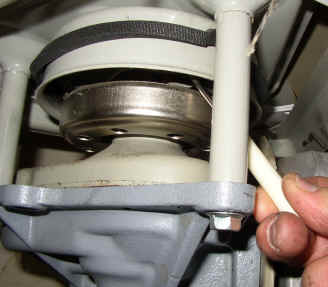
Put a 1/4 inch 'dab' of silicone grease
on the end of a small screwdriver (I'm using the pen-sized one carried in my shirt pocket in the picture above), and look up into this brake drum.
You'll want to insert the screwdriver
between the brake coil spring and the inside of the drum. Apply
the grease to the inside of the brake drum. The tub can usually be rotated
by
hand to bring this spring around. It's nice to have a helper
slowly turn the tub from above while you watch the spring's
location. (I've never had a helper to do this, but it'd be nice ;-) )
Be sure you're putting this into the
inside vertical surface of
the
UPPER, painted (brake) drum, and NOT the chrome (clutch)
drum below it.
It would be very hard to put grease on
the clutch linings inside
the lower clutch drum, but I mention the
possibility just in case
there's a 'Tim Allen' type (like my dear brother!)
out there who
might take the 'more is better' approach. ;-)
That's it! Solves the brake lockup problem, and it
usually doesn't come
back! No pulling the motor, gear case, pump, or any of
that
fun
stuff like I used to! As my daughter would say, 'sweet!'
Was this article helpful?
Please click the "donate" button on the left side of
this page to help me keep this information free!
Many Thanks! - Dave
Copyright www.DavesRepair.com
This article may be reprinted and distributed freely only
in its entirety, including this message.
|